
’28 Years Later’ Movie Review – Is It Worth Watching?
🎬 At a Glance
- Director: Danny Boyle
- Screenplay: Alex Garland
- Cast: Aaron Taylor-Johnson, Alfie Williams, Jodie Comer
- Genre: Post-Apocalyptic Action-Horror
Spling’s One-Liner: “This well-acted, visually-striking, more emotional post-apocalyptic action-horror has some slower moments and functions as a Part 1.”
Final Verdict: 7 / 10
28 Years Later is the third film in the 28 Days Later franchise, serving as a direct follow-up to the acclaimed zombie classics from Danny Boyle and Alex Garland. Set in a post-apocalyptic world decades after the initial outbreak of the infectious virus in the United Kingdom, the film feels remarkably timely in the wake of our own recent pandemic experiences, rendering the horror that much more visceral.
In this installment, the narrative tracks the coming-of-age tale of Spike, a young boy learning to fend for himself under the guidance of his disciplinarian father, who equips him to hunt the undead and protect their way of life. Based on an island where the tide only grants access along a narrow path a few times a day, this fortified community is almost impossible for the undead to reach. However, the residents must still venture to the mainland to gather essential resources.
Centred on a family of three, the story primarily grapples with Spike’s father, Jamie, who is determined to accustom his son to killing so he can defend himself. Meanwhile, his mother, Isla, is deeply afflicted – bedridden and struggling to rally her failing health in their small village. Seeking to prove himself, Spike joins his father on a hunting trip to the mainland in spite of his mother’s deep concerns. The duo embarks on a high-stakes quest that secures Spike his first kill, but also comes perilously close to ending it all.
Boyle’s re-entry into this universe is just as grisly and visceral as his previous work, populated by a wild array of eccentric characters. While a bit lopsided, the film introduces Jimmy and Dr. Kelson, two figures who go on to play much larger roles in the follow-up, 28 Years Later: The Bone Temple. Because of this setup, while the action-horror thriller serves its purpose with thrilling set pieces and gruesome sequences, it ultimately feels like a Part 1.
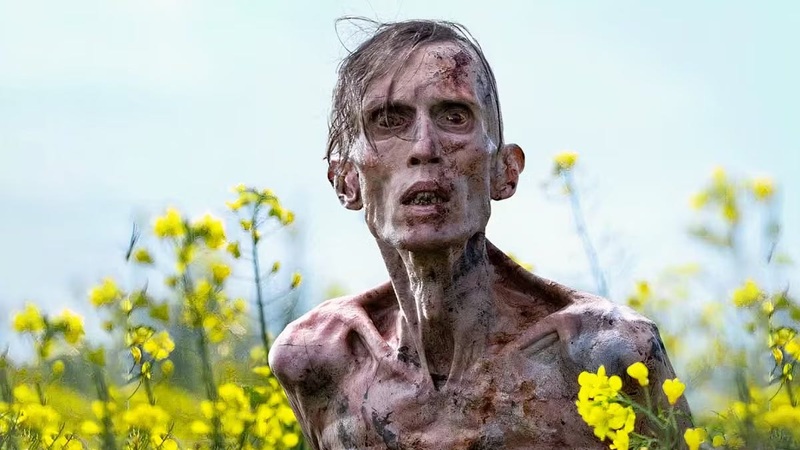
“What… is there something on my face?”
This sequel is also curiously edited, interspersing archive footage of historical wars and archers to serve as a stark contrast to the modern affliction and post-apocalyptic human devastation. The eclectic quick cut interspersion is mostly effective, even if a bit disjointed. Ultimately, Boyle has delivered a much more emotional drama here, though it is intermittently offset by bursts of high-intensity action and horror.
The film also introduces Samson, an imposing Alpha character who features more prominently in the subsequent Bone Temple. Overall, 28 Years Later is an ambitious undertaking that mostly delivers on its promises, boasting beautiful cinematography and capable performances that keep the audience emotionally invested. On the surface, it’s a fairly simple story about a community trying to protect its livelihood, driven by a young boy who realises his mother desperately needs a doctor, sparking a dangerous quest to reach answers and a safe haven.
To complicate matters, the film is bookended by a narrative strand that could have easily been its own movie: the rise of a blonde, Teletubby-inspired gang under the nefarious Jimmy. While this subplot makes far more sense in The Bone Temple, it feels quite adrift and even absurd as a closing note for 28 Years Later. Having the context of The Bone Temple as a “Part 2” certainly helps, but as a standalone experience, 28 Years Later proves rather confusing in the way it starts and ends with a completely different character’s story.
Performance-wise, Aaron Taylor-Johnson shines as Jamie, channeling a brutal, anti-Robin Hood energy, while Alfie Williams delivers a strong performance as his determined son, eager to step up and protect his mother at all costs. Jodie Comer retains an air of tragic mystery as the ailing Isla, while Ralph Fiennes adds a morbid, Apocalypse Now enigma and spirit to the proceedings.
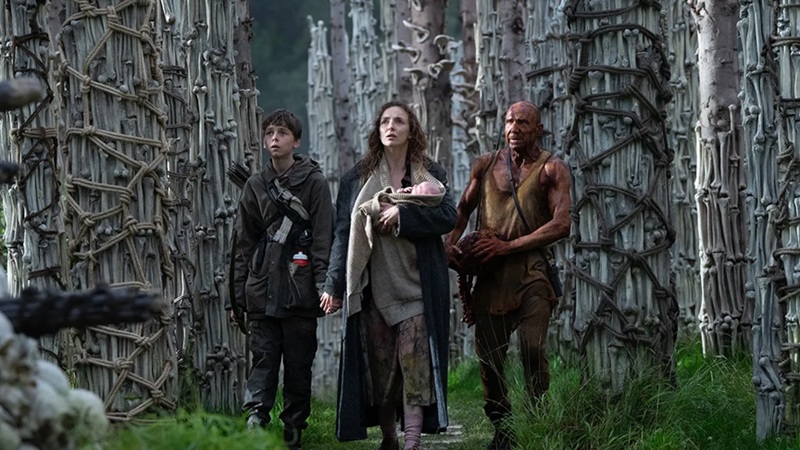
As the characters traverse the terrifying mainland and work together to survive, the luscious, overgrown setting creates an eerie contrast with the bloodthirsty and savage events unfolding within it – echoing a sense of lockdown rehabilitation. 28 Years Later does suffer from some slower moments that might jar fans of the fast-paced original, but it offers a much more substantial, philosophical take on the quest for humanity in the darkest places.
The mystery surrounding Dr Kelson, Jimmy and Samson is genuinely intriguing. Thankfully, the questions raised here are eventually answered by The Bone Temple. Ultimately, there are mesmerisingly beautiful moments in 28 Years Later that make it an entertaining and enjoyable spectacle anchored by solid performances and heartfelt emotion. Yet, because the narrative tension occasionally slackens, the suspense is not quite as relentless as previous iterations. Still, given the high quality of the ingredients, it remains a fine production, even if it somewhat loses its way toward the end.
One-liner: Ambitious


