

‘Knife: The Attempted Murder of Salman Rushdie’ Movie Review – Is It Worth Watching?
🎬 At a Glance
- Directors: Alex Gibney
- Writer: Salman Rushdie
- Cast: Salman Rushdie, Rachel Eliza Griffiths
- Genre: Documentary
Spling’s One-Liner: “A quietly powerful character portrait and defiant documentary chronicle of an extraordinary, thoughtful and reclusive author.”
Final Verdict: 8/10
Knife: The Attempted Murder of Salman Rushdie is a documentary that centres on a pivotal moment in the life of Salman Rushdie, the famed British-Indian author of ‘The Satanic Verses’. Rushdie fell into infamy after the book’s publication sparked worldwide outrage and accusations of blasphemy among Muslims, leading to a bounty (fatwa) being placed on his head in 1989 by Ayatollah Khomeini of Iran. Following these events, Rushdie led a secluded life, constantly looking over his shoulder and surveying potential threats.
But after moving from one big city to the next, he finally decided to come out of hiding in a bid to reclaim his public life and freedom, having lived under the shadow of the fatwa for over three decades. While his shift back into the public eye initially seemed seamless – as he was photographed at numerous high-profile events – it was during a talk at the Chautauqua Institution that an assailant (Hadi Matar) managed to stab him repeatedly, almost taking his life. Starting with a close-up dramatisation from Rushdie’s perspective of what that proximity felt like, the documentary rewinds the story from his vantage point in a hospital bed.
He and his wife, Rachel Eliza Griffiths, decided to document his healing process, capturing the immediate aftermath of an attack that made international headlines. Recovering in the hospital after having numerous wounds attended to, Rushdie’s body is inflamed and his eye bulges, while doctors and nurses tend to his critical condition with the utmost care, charting his progress with a day counter. This biographical retrospective gives audiences a clearer understanding of why he initially retreated from the public eye, using news footage to capture the intense reaction to his bestselling, fictional book and its tie-ins with Islam.
Many nations were incensed by insinuations that the author himself later clarifies and downplays. At the time, with little information at their fingertips, people let their imaginations run wild, and the documentary shows how this snowball effect motivated crowds to take to the streets. While the story takes place on a global platform, ultimately, this is a deeply personal character portrait of the author.
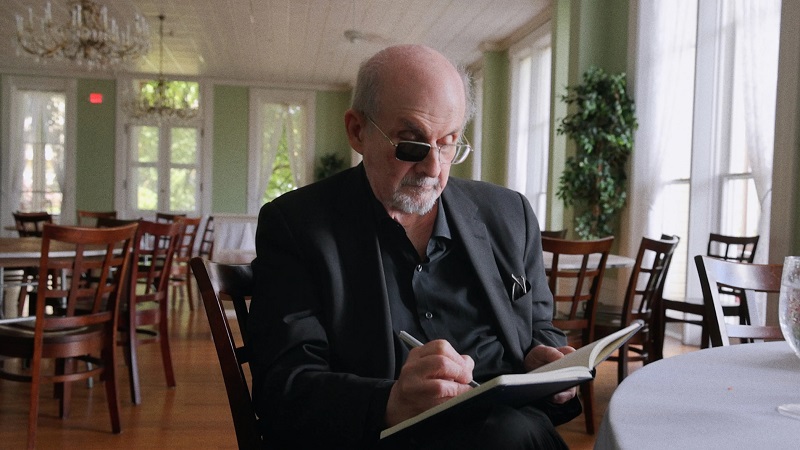
“It’s time I write about a wrong.”
Director Alex Gibney retraces the steps that led to this knife attack in an open auditorium. Based on his memoirs, Knife serves as a comprehensive overview of this moment in time, tracking Rushdie’s career and personal life while focusing heavily on his recovery alongside his wife, who features prominently in the footage of his recovery. This documentary serves as an intimate account of a massive personality finally having the time to reflect.
It’s curious to hear Rushdie’s attempts to rationalise the event as he tries to make peace with the assailant’s motivations. It is also fascinating to consider why a 24-year-old felt the need to follow through on this hit, though the film keeps its focus squarely on Rushdie. This project is not an opportunity to give the assailant more spotlight. While the attack is covered in some detail, the real focus is on the metaphor of the knife itself, and how it can be used as a tool for either good or evil. The result is a powerful testimony about reclaiming one’s life, overcoming fear and making the most of the time you are afforded.
Knife is a layered and introspective documentary that gives unprecedented, if somewhat reserved, access to a reclusive author. Rushdie’s up-close and personal interviews help shape our understanding of the man and his close relationship with his wife. An intellectual, he guides the narration with insight and wit, offering candid and thoughtful discussion around his near-death experience and its life-changing implications. This is seamlessly woven together with deep-dive archival footage, hospital-bed coverage, and his eventual return to the site of the incident.
Alex Gibney’s film takes a quietly powerful approach, moving from the confines of the hospital room to the world beyond. The dualities of privacy and public life are contrasted starkly as Rushdie attempts to find freedom through it all. For viewers who may have a limited understanding of Salman Rushdie’s history but are aware of his literary respect, Knife: The Attempted Murder of Salman Rushdie is an eye-opening chronicle of exactly who he is, what he stands for, and how far he has come since the incident. Getting this intimate account is a way to silence the critics, bypass the noise and gain a clearer understanding of an extraordinary life.
The bottom line: Defiant


