‘Unabomber’ Movie Review – Is It Worth Watching?
🎬 At a Glance
- Director: Janus Metz
- Screenplay: Sam Chalsen, Nelson Greaves
- Cast: Russell Crowe, Jacob Tremblay, Shailene Woodley, Annabelle Wallis
- Genre: Biographical Crime Drama / Psychological Thriller
Spling’s One-Liner: “A dignified, slow-boiling, and well-acted thinking person’s thriller, Unabomber delivers a thought-provoking psychological origin story elevated by an unsettling clash of intellects.”
Final Verdict: 6/10
Unabomber is a crime drama from director Janus Metz that centres on one of the most extensive and costly manhunts in American history: the decades-long FBI investigation that led to the capture of Ted Kaczynski, a domestic terrorist notorious for his deadly mail-bomb modus operandi. Operating across nearly two decades, Kaczynski instilled nationwide dread among parcel recipients and infamously coerced The New York Times and The Washington Post into publishing his anti-technology manifesto. A reclusive, countercultural figure whose radical writings and lethal bombing campaign – killing three people and injuring 23 others – made him both monstrous and enigmatic.
Recently, Sharlto Copley starred in Ted K, which sought to inhabit the Unabomber’s fractured headspace and untamed spirit through an unconventional, raw character study. Anchored by a fierce performance from Copley, that film offered an intimate perspective on Kaczynski’s volatile interior world, made all the more topical following his death in prison in 2023. While Ted K focused on the man’s unravelled psyche and reclusive life hidden away in the Montana wilderness, Unabomber takes a distinctly different narrative tack. Rather than dwelling predominantly on his cabin years, Metz explores the root of his radicalisation by journeying back to his formative period at Harvard as a gifted teenage prodigy enrolled in a psychologically gruelling university experiment. While the story is rooted in history, the filmmakers have taken creative license in terms of character and focus.
Here, a young Theodore Kaczynski is drawn into an ethically dubious psychological research programme overseen by Professor Henry Murray and his collaborator Christiana Morgan. Subjected to intensely combative debate sessions opposite an older interrogator—designed to systematically dismantle his core philosophical beliefs and measure his ability to withstand psychological humiliation – Theodore is pushed to his limits. In adapting to the emotional abuse, he alienates his family and develops a toxic, codependent relationship with his mentors, laying the bitter ideological groundwork for his infamous treatise, Industrial Society and Its Future, and his violent life’s work.
Framed around the months leading up to his 1996 arrest and interwoven with extensive flashbacks to his university days in the late 1950s, the film functions as a curious psychological origin story. It reflects on what drove Kaczynski to execute these calculated, lethal attacks under the delusion of liberating humanity from systems he deemed irredeemably corrupt.
There is a strain of empathy in Unabomber, striving to comprehend the psychological fracture that compelled Theodore to adopt such extreme militancy. Whilst the filmmakers portray him as an impressionable youth exploited by institutional hubris, they are careful not to treat Murray’s experiments as a complete scapegoat, framing them instead as a tragic catalyst. Casting Russell Crowe as Professor Murray is an inspired stroke that knowingly evokes his performance in Ron Howard’s Oscar-winning A Beautiful Mind. Metz’s film clearly aspires to that same prestige, exploring parallel themes of mathematical genius, severe social alienation, and psychological unraveling. In many respects, Unabomber serves as the dark antithesis to A Beautiful Mind – a tragic inversion where a warped intellect fostered delusions of philosophical enlightenment.
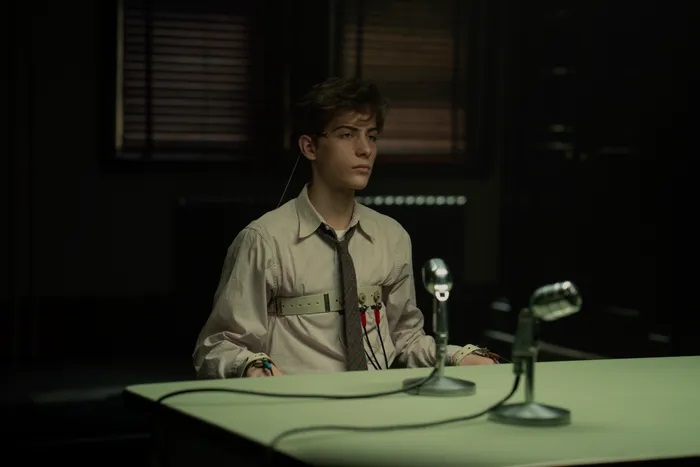
“Is it too late t phone a friend?”
The film’s prestige ambitions are evident. With its low-lit palettes, investigative backroom politics and procedural dread, it shares stylistic similarities with David Fincher’s Zodiac. Yet it also frequently adopts the measured, dialogue-heavy rhythm of The Social Network, through clandestine arguments, intellectual sparring and bureaucratic friction across its two converging timelines.
In the Harvard sequences, Russell Crowe, Jacob Tremblay and Annabelle Wallis command the screen, capturing the stuffy atmosphere of mid-century academia. The clinical debate trials crackle with claustrophobic tension – high-stakes battlegrounds where intellectual dominance is weaponised to break an opponent’s spirit. This institutional cruelty creates an unsettling, claustrophobic environment that Tremblay inhabits with raw vulnerability.
When shifting to the 1990s timeline, the focus pivots to the procedural mechanics of the FBI task force. Shailene Woodley leads the charge as Agent Joanne Miller, a tenacious investigator who takes the elusive bomber’s capture deeply to heart. Flanked by a dependable supporting cast – including Alexander Ludwig and Steven Ogg – Woodley navigates the grit of low-level breakthroughs, jurisdictional tensions and media pressure, piecing together seemingly disparate clues from linguistics to family estrangement.
Unabomber builds a creeping sense of tension, starting at a deliberate pace before gradually tightening the vice towards its inevitable climax. Tremblay, Crowe and Wallis provide a compelling dramatic counterweight in the past, lending psychological weight to the procedural efforts anchored by Woodley in the present. While the script doesn’t pander to traditional heroes, Woodley’s gritty conviction mostly anchors the ensemble.
Though somewhat slow-moving, Unabomber is a handsomely crafted, atmospheric drama that takes the time to immerse viewers in both periods. Even if one knows the historical outcome, the focus on Kaczynski’s early psychological conditioning provides chilling new insights into his descent, sustaining steady suspense up to his eventual arrest.
Elevated by sharp dialogue and strong central performances, Unabomber aims high in its quest to capture the dramatic heft of classic biographical thrillers. While it dares to humanise a monster, it stops short of excusing his crimes, functioning instead as a sober, thought-provoking examination of an alienated outlier who took his radical philosophy to its deadliest extreme. Ultimately, it’s a thinking person’s thriller that delivers a compelling juxtaposition of psychological drama and true-crime investigation.
The bottom line: Cerebral