

Movie Review: Train Dreams
One-liner: Vivid and lush visuals, emotive themes and solid performances power this slow-moving yet wistful and poetic portrait.
Train Dreams is a poignant character portrait drama centred on Robert Grainier, a logger set against the rugged landscape of the Pacific Northwest at the turn of the 20th century. While the film touches on the discrimination and hardships of the early timber industry – offering a subtle social commentary on deforestation and the expansion of the railway – it isn’t driven by a political agenda. Instead, it offers a haunting retelling of a man’s existential journey. Based on the celebrated novella by Denis Johnson, the story follows Grainier as he comes to terms with his lot in life and attempts to make sense of his growing estrangement. This deliberately slow-moving, almost ethereal film is deeply immersive, gliding along with uncommon grace.
The first thing you’ll notice about this film from writer-director Clint Bentley is the breathtaking cinematography. Set against a lush backdrop of cabins by streams and ancient, thick forests, the film finds a harmonious visual balance between man and nature. The conflict arises through the vocation of tree-felling; Grainier begins to realize the heavy trade-off between his industry and his soul. Though he finds his “true north” through love and family, his long logging expeditions frequently pull him away – until it’s too late.
There’s a romantic, soulful touch to Train Dreams, capturing an Into the Wild spirit of living in harmony with the land. The storytelling is fluid, blending dreams and reality through a relatively seamless edit that trusts the audience rather than “spoon-feeding” the plot. These nostalgic snapshots of life provide a lifelike flow, punctuated by moments of quiet intensity.
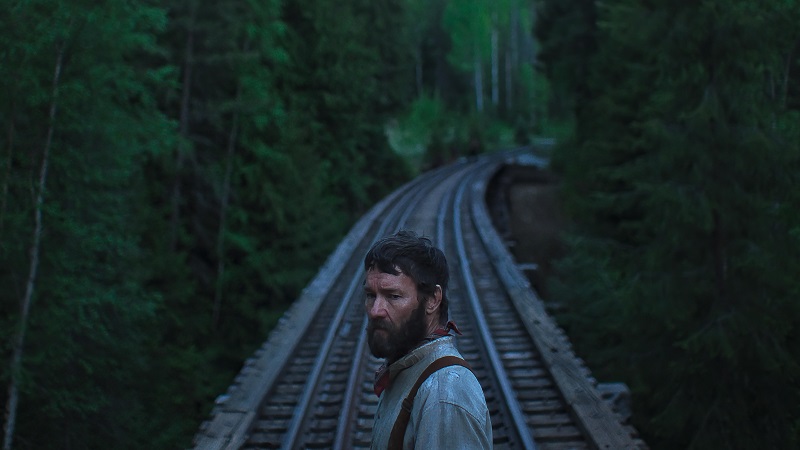
“I don’t know where I’m going to…”
Joel Edgerton excels as Robert Grainier, an enigmatic, salt-of-the-earth man who stoically carries the weight of a great trauma. Edgerton operates in a delicate “push-and-pull” space, offering a performance that is both gentle and determined. He’s close enough to feel intimate, yet distant enough to remain a mystery. Felicity Jones plays opposite him as his one true love, Gladys, providing a grounded performance that allows the “dream life” segments of the film to reverberate with emotion – not unlike The Grey. Perhaps most remarkable is William H. Macy, who adds a surprising dimension in one of his most transformative, “un-Macy-like” supporting roles to date.
The soundtrack is just as affecting as the visuals, leaning into a ghostly, melancholic tone that complements the film’s surreal quality. It depicts a luscious world before the advent of modern technology, creating a curious nostalgia for simpler times. This void of modern screens offers a valuable retrospective: a tale of one man’s attempt to find internal peace despite his emotional turmoil. This personal struggle is contrasted against the overarching story of America’s technological advancement – a machine churning through natural resources without questioning longevity or sustainability.
While the pace is contemplative, this beautifully crafted and enigmatic character portrait is elevated by solid performances and a wistful tonal quality. It’s a moving meditation on love and loneliness, captured through immersive world-building and powerful visual storytelling.
The bottom line: Poetic


