‘Michael’ Movie Review – Is It Worth Watching?
🎬 At a Glance
- Director: Antoine Fuqua
- Screenplay: John Logan
- Cast: Jaafar Jackson, Colman Domingo, Nia Long, Miles Teller
- Genre: Musical Biopic
Spling’s One-Liner: “A transformative lead performance, enduring music and spectacular re-enactments power this dazzling, entertaining albeit superficial music biopic.”
Final Verdict: 7 / 10
Michael is a music biopic from director Antoine Fuqua and producer Graham King, who brought Bohemian Rhapsody to life. The Freddie Mercury film was a smash hit, reigniting Queen’s legacy for a new generation through an Oscar-winning performance from Rami Malek. Following a fairly typical rock-and-roll trajectory, that film’s true impact was felt through its spirited lead performance and a powerful, meticulously accurate reimagining of their Live Aid concert.
Michael follows an even bigger superstar in Michael Jackson – an iconic, world-famous pop titan who left an indelible impression on the music industry. A true superstar in every sense, he amassed legions of global fans, cutting across borders, race, and language with his powerful music and choreography. However, serious allegations about his personal life eventually cast a long shadow over his legacy. Speculation began around the star’s own childhood; many news stories and a few documentaries later, the world remains divided on the infamous King of Pop.
While his personal life has complicated his musical legacy, the debate over separating the art from the artist rages on. Based on the crowd-pleasing appeal of this musical odyssey, it’s clear that the pop star’s signature flair, immense talents and enduring discography live on. Michael isn’t so much an intimate character portrait as it is a spectacle geared toward maximum entertainment value, harnessing nostalgia to relive Jackson’s greatest hits. It was cut down from a 4-hour version and faced some issues relating to the depiction of the singer’s accusers.
A chronicle of his youth, Michael starts with the artist in his family living room, rehearsing with his four brothers under the watchful eye of their domineering father, Joseph Jackson. Made to work grueling hours to perfect the Jackson 5 act, Joe Jackson becomes the narrative’s primary villain in his effort to control his children’s lives and profit as their manager. This hostile environment provides the backdrop for Michael’s split from the group and eventual solo career, charting how he finally cut the apron strings to become his own man. Much like Elvis, the friction between the star and his representation drives the central dramatic tension as Michael seeks to outgrow a naive contract arrangement and find independence.
John Logan’s script emphasizes Jackson’s diligence, innate talent and a lifelong Peter Pan syndrome, finding him yearning for Neverland with a clear nod to his ceaseless battle with Captain Hook. This parallel rings true when you consider his brothers the “Lost Boys,” with Wendy represented by his mother and the crocodile of fame serving as a strong metaphor for the media circus, all backed by the emotional trauma underlying his relationship with his father. Because of this, there is real substance to be found beneath the dazzling feature film.
“Ma-ma-se, ma-ma-sa, ma-ma-coo-sa.”
While it possesses dramatic subtext, Michael focuses heavily on Jackson the entertainer rather than cracking the facade of a private, painfully shy individual. It is understandable why it’s tricky to truly mine the depths of someone who kept the world at arm’s length; consequently, it is easier to let the music do the talking. That is exactly how Michael operates, following a path similar to Bohemian Rhapsody – a nod cemented by the shot of Michael jumping up and down before a performance, which bookends the film. Michael functions much like a Greatest Hits album, leaning into its crowd-pleasing nature and ensuring there is never a dull moment.
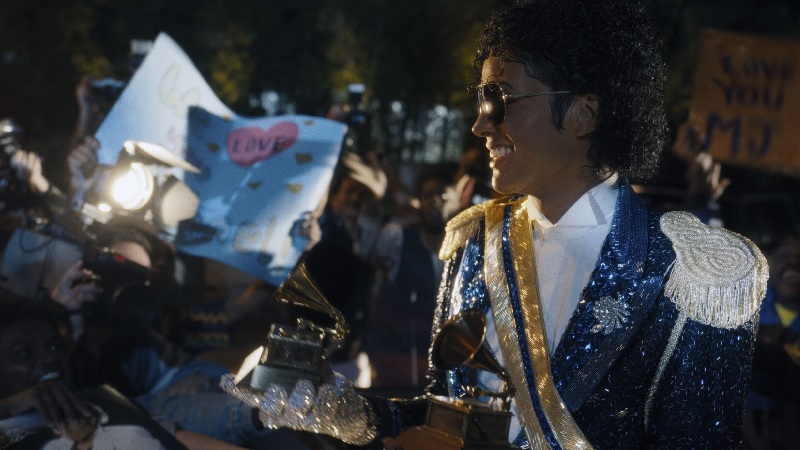
This is anchored by a brilliant lead performance from Jaafar Jackson, who embodies his uncle so effortlessly that the line between actor and icon blurs. The impersonation is near-perfect. Michael Jackson underwent a massive physical transformation throughout his life, both as a growing young man and facially, and this evolution is masterfully handled across the eras. From his vocal inflections and facial expressions to his stage movement and singing, Jaafar delivers an awe-inspiring transformation that should command the same award-season attention afforded to Rami Malek. Furthermore, by avoiding some of the more dated elements of the era without erasing them entirely, the film softens the garishness of the ’80s to maintain a sleek, timeless aesthetic.
It is no secret that Michael is the solar system around which the film revolves, meaning most supporting characters are fairly superfluous in the grand scheme of things. Notably, Janet Jackson did not want to be included in the film – a decision that may backfire regarding the movie’s purported history, which, given its mainstream popularity, could inadvertently rewrite actual history for the collective hive mind. Aside from a solid turn by Miles Teller as John Branca, the only other standout performance comes from Colman Domingo, who plays Joseph Jackson as a tyrant destined to be Peter Pan’s Captain Hook.
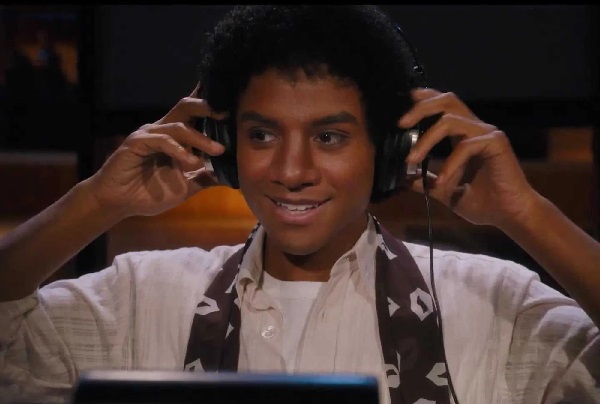
There is a fascinating psychological tension to their bouts, especially as an adult Michael begins employing others to do his bidding as a coping mechanism. The film threads the Jackson 5’s greatest hits together with tracks from Thriller, which was a greatest hits album in its own right for the era. It is genuinely fascinating to go behind the scenes of his iconic music videos and witness his inspirations in the recording studio. The film cleverly constructs the stories behind the songs, interlinking them for a free-flowing, vicarious fan experience that even touches on a Doctor Dolittle element regarding his eccentric pet acquisitions.
Viewers walk away with a full appreciation for the boundless imagination, fame and power that came with being Michael Jackson. While the film doesn’t give its supporting cast much room to breathe, it plays heavily to its strengths: Jaafar Jackson’s talent, the music and the mythos of the man.
Building toward his final performances and ending simply with a sense that “the story continues”, it feels very much like a “Part One” with a sequel intended to follow. Jaafar Jackson’s intricate, sensitively handled performance is the primary reason to see Michael. It is bolstered by emotive renditions of the Jackson catalogue and seamless modern visual effects that echo the scope of Bohemian Rhapsody. Yet, while it is an improvement on Bohemian Rhapsody in terms of its lead actor’s total physical transformation, the film ultimately feels more superficial in its psychological handling of its subject.
In this way, this empathetic, safe retelling keeps the audience at a slight distance, choosing instead to highlight the brightest moments of the star’s career. By focusing on the golden eras before major scandals broke loose, the film conveniently avoids the skeletons in the closet. It channels all its energy into the excitement, entertainment value and pure spectacle of the performer rather than truly getting to grips with the person. That may be exactly how Michael Jackson chose to live his life, but while this extravaganza is highly enjoyable, its superficial approach remains hard to ignore.
The bottom line: Spectacular